Literature review matrix
- Hours of extraction
- 15.1
- Cells in the matrix
- 252
- Cells done twice
- 50
- Cells somebody has to fill
- 302
Every figure on these worksheets is one you typed. Where a page states something outside your own review, it names the document it came from and the day it was read.
The figures open on a worked example (15.1) from a real-sized review. Change any of them and the answer moves as you type.
Download the Literature review matrix worked example (CSV)
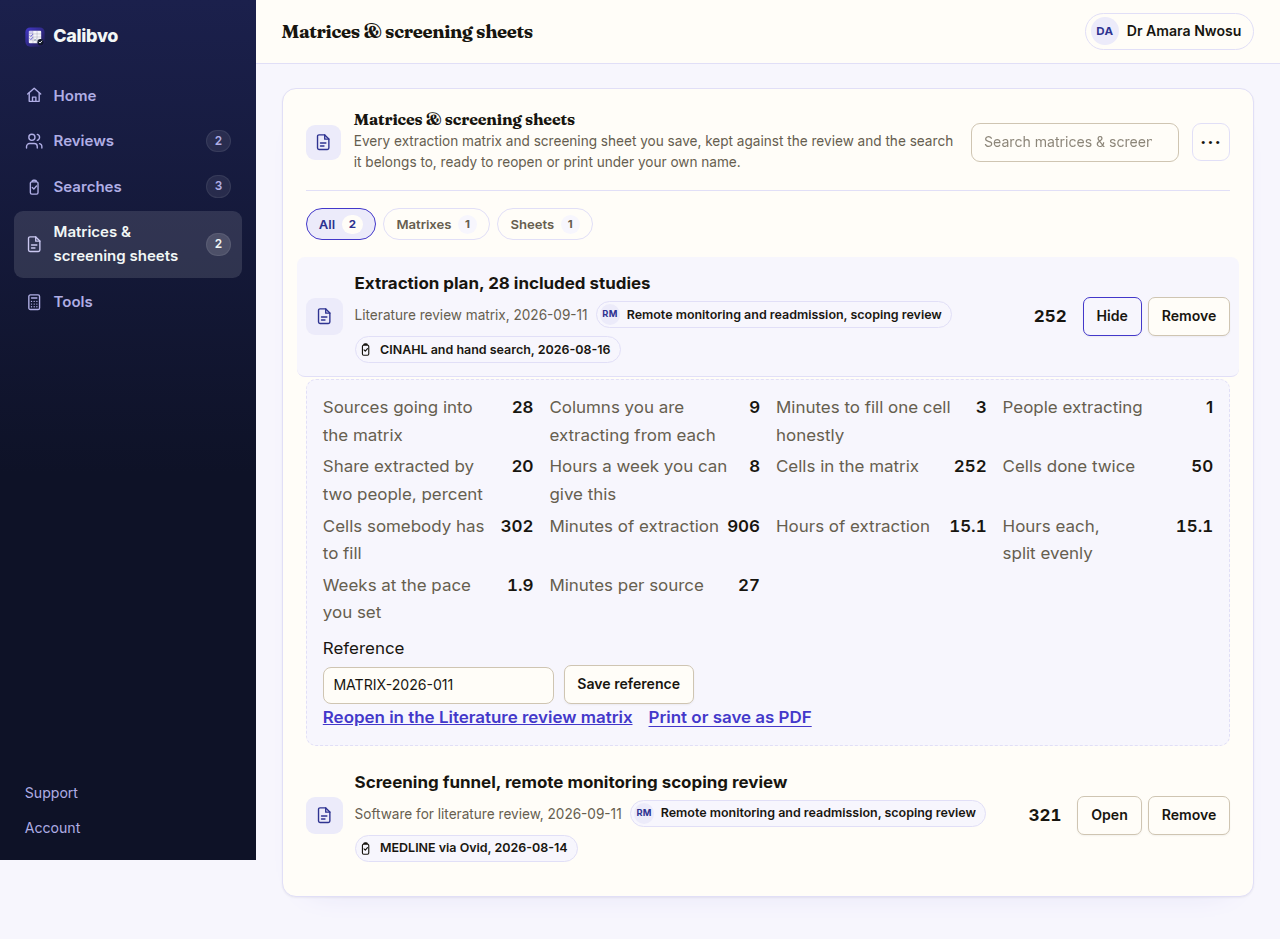
This worksheet works out what the extraction matrix is actually going to cost you in hours before you start filling it. Put in the sources that survived screening, the columns you have decided to pull from each, how long one cell honestly takes, how many people are extracting, how much of it you are double-extracting and how many hours a week you can give it. Out comes the number of cells, the hours, the hours each and the weeks, which is the number people get wrong by a factor of three when they plan a review chapter.
What reviewers ask about the Literature review matrix
What columns should a literature review matrix have?
The ones your review question needs, decided BEFORE you start reading, which is the whole trick. A workable default is source, design, setting, sample, what was measured, the main finding, the limitation that matters, and your own note on relevance; the worked example on this page uses nine columns across 28 sources. Adding a column halfway through means re-reading everything you have already done.
Why does double extraction matter?
Because a single reader silently disagrees with themselves as the weeks go on, and a second reader on a sample is the cheapest way to find out. The worked example puts a fifth of the cells through twice, which adds about a fifth to the hours and is the difference between a matrix and evidence. In a systematic review the guidance goes further and expects it on everything.
How long should I budget?
Whatever this worksheet says with honest inputs, which is usually more than the plan allows. The worked example, 28 sources and 9 columns at 3 minutes a cell with a fifth double-extracted, is about 15 hours of extraction alone, or two weeks at 8 hours a week, before any of it is written up.
Where the constants in this tool come from
Cochrane Handbook for Systematic Reviews of Interventions (current version). The method text behind double screening, data extraction forms and why a reason is recorded against every exclusion. Read 2026-09-11.
The Literature Review, Organizing Your Social Sciences Research Paper (USC Libraries research guide). A standard account of what a literature review is and what a finished one contains, for the reviewer deciding which columns the matrix needs. Read 2026-09-11.