Software for literature review
- Studies included
- 28
- Unique records after de-duplication
- 321
- Full texts to read
- 58
- Minutes of title and abstract screening
- 321
Every figure on these worksheets is one you typed. Where a page states something outside your own review, it names the document it came from and the day it was read.
The figures open on a worked example (28) from a real-sized review. Change any of them and the answer moves as you type.
Download the Software for literature review worked example (CSV)
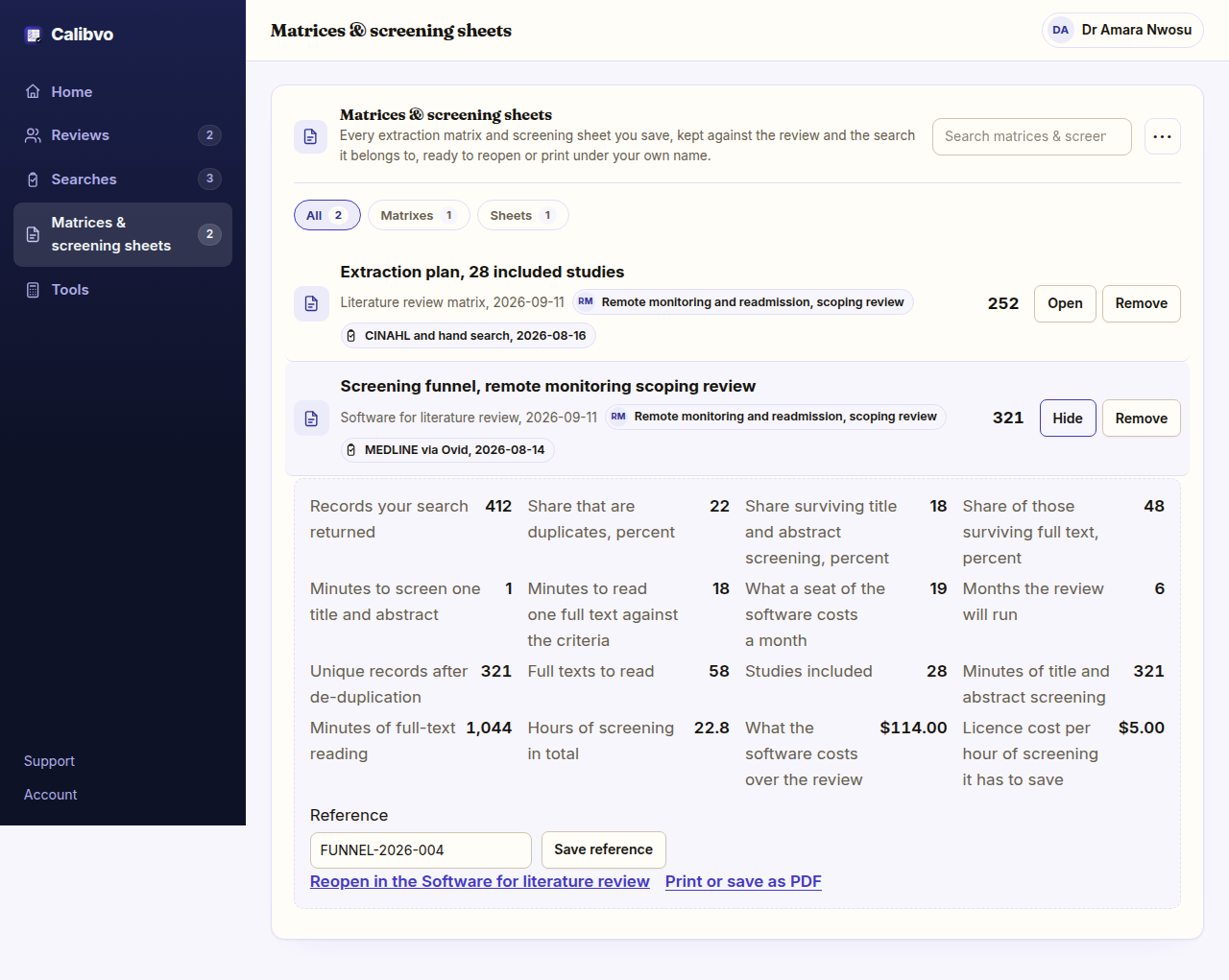
This worksheet is the screening funnel, and it is what tells you whether review software is worth paying for. Put in the records your search returned, the share that are duplicates, the share surviving title and abstract screening and the share of those surviving full text, plus how long each kind of read takes and what a seat costs. Out comes the unique records, the full texts to read, the studies included, the hours of screening, and what the licence costs per hour of screening it would have to save.
What reviewers ask about the Software for literature review
What software do I need for a literature review?
Below a few hundred records, a reference manager and this worksheet, and nothing else. Above that, or with two reviewers screening the same set, a dedicated screening tool starts earning its licence back in hours saved and in arguments avoided. The worked example here runs 412 records to 28 included in a little over 24 hours of screening, which is the right size of number to judge a subscription against.
Why does the duplicate rate matter so much?
Because it is the first place software pays for itself and the first place a spreadsheet fails quietly. Four databases searched the same way will return the same paper four times, and the worked example strips roughly a fifth of the records before any human reads a title. A duplicate that survives into screening gets read, decided and sometimes decided differently the second time.
Are these percentages realistic for my review?
They are a starting point from a broad clinical-style search, and they are yours to replace. A narrow topic keeps far more at title stage; a scoping review across a big literature keeps far less. Run your first fifty records, take the real percentages from those, and put them in here.
Where the constants in this tool come from
PRISMA 2020 statement. The reporting guideline that defines what a review has to be able to state: the records identified, the duplicates removed, the records screened and excluded, and the studies included. Read 2026-09-11.
Cochrane Handbook for Systematic Reviews of Interventions (current version). The method text behind double screening, data extraction forms and why a reason is recorded against every exclusion. Read 2026-09-11.